After taking some shots t the NIE pond, I took a casual walk along Nanyang Crescent. I noticed quite a number Bush Brown butterflies (Mycalesis species) fluttering on a grass patch. A deformed but relatively tame Nigger (Orsotriaena medus cinerea) was my first model along a forest fringe.

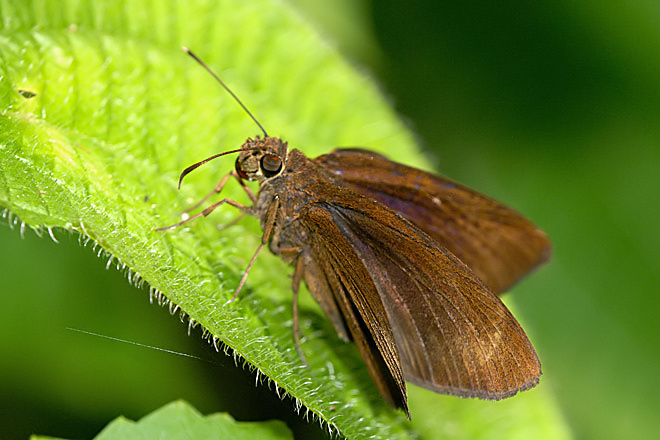
The weather wasn't ideal for butterfly hunting as dark clouds assisted by strong winds congregating rapidly. With an umbrella in my camera bag, I continued walking towards Nanyang Avenue. On a quiet corner, a brown skipper which looks like a Small Branded Swift (Pelopidas mathias) was still taking a nap in a cool morning.

At the junction of Nanyang Avenue and Nanyang Crescent, I noticed at least half a dozen Jamides were fluttering in the breeze. My instinct told me that this particular lycaenid may not be a Common Caerulean (Jamides celeno aelianus). I waited patiently and took some a few shots when it settled down on a twig. According to Dr Seow, this may be J. pura but without a clear upperside view, we can't be absolutely sure of the species.
 I followed a walking path that led me into a forested area and was rewarded with a few shots of a Biggs's Brownie (Miletus biggsii biggsii ) and a group of big wild fungus.
 Just before a heavy downpour in the late morning, I took a long-distance shot of a puddling orange butterfly before it took off hastily. A few days later, I realised that I had accidentally shot a new butterfly species for Singapore - the Common Jester (Symbrenthia hippoclus). You may want to read a detailed write-up posted on the ButterflyCircle's Blog.


 Apart from building webs to trap insects, some other spiders are endowed with special offensive skills such as lurking amongst flowers or foliage to hunt for their preys. It is not easy to spot a crab spider when it is well-blended with its surroundings.
  This poor Chestnut Bob (Iambrix salsala salsala ) was killed by a crab spider hiding in some
 I was rather fortunate to find a tame Peacock Pansy (




 At the same place where the orange skipper was. an intimate pair of Common Three Ring (
 At least three Painted Jezebel ( Delias hyparete metarete ) were fluttering at the tree top which is their usual habit.
 Between moments of chasing and frolicking amongst themselves, occasionally they would come down to the eye level to feed - this would be the best opportunity to snap a shot of a very alert and active species. Here is a lucky shot of a male.


 I like the creamy background created by clusters of flowers but the spots on the wings of this shot puzzle me - I guess this is another specimen of a King Crow.
 It can be regularly sighted near our mangroves areas where the larval host plant - the Pong Pong Tree (Cerbera odollam), a fast growing evergreen tree is abundant. Whenever King Crows perch on a new landing for feeding, they tend to flap their winds initially - this was how I managed to get a few open-winged shots.
  The King Crow butterfly behaves like many other species in the Euploea genus. They are not a very fast flyer because birds and other predators know that they are unpalatable. It was a magnificent scene to see when these Crows and other buuterflies dancing and feeding in the wind, displaying all sorts of stunts and movement.
 This is its underside shot when it was high up.
 Striped Black Crow (Euploea eyndhovii gardineri) appeared for a short while or was it hiding high on the tree ?
  A Striped Blue Crow (Euploea mulciber mulciber) showed up around 2 pm. Rather skittish bugger, it never remained in a good pose for me to get a good shot.


 This female Cabbage White was raising her abdomen when a male was trying to "harass" her.
