Showing posts with label Lornie Trail. Show all posts

Friday, September 3, 2021

Common Butterflies Along Lornie Trail and Lornie Nature Corridor

We lost some greenery and cemetery ground at Bukit Brown due to the construction of the Lornie Highway but we gained a very serene and beautiful Lornie Nature Corridor.  Since its official opening in Nov 2020, this 1.7 km nature corridor has become one of my favourite hiking cum butterfly-photography trails.

The nature corridor runs parallelly to the old Lornie Road.  Flowering shrubs such as Leea rubra and different kind of tropical trees with name and descriptions are planted along the road.

There are two entrance points to the MacRitchie Reservoir Nature Reserve. Usually I went into the nature reserve and came out from the other entrance point near the golf course.  

A long-tailed and elegant lycaenid, the Branded Imperial (Eooxylides tharis distanti) is a common denizen in the forest. Very often, this species loves to perch on its larval host plant, a forest climber the Bearded Smilax (Smilex bracteata). 

A rare occasion like this is what we hope for - two in one frame is nice (yes, forget about the restrictions of "social distancing"!) 

Another orange lycaenid, the Yamfly (Loxura atymnus fuconius) was spotted hopping at the same Smilax vine. This was not a surprise as its larval host plant is the same vine. 

Occasionally, it opened its wings partially enjoying the sunshine. 
Another common beauty that can be found along the stretch of forest trail that is parallel to the nature corridor is the Common Posy (Drupadia ravindra moorei).
The reservoir edge next to the Chemperai hut is where I usually shot dragonflies and damselflies. This is the male Scarlet Pygmy (Nanaophya pygmaea) - one of the smallest dragonfly in the region.    

Another small dragonfly found at the same location. I am not sure what this is.

I am almost sure to see Chocolate Grass Yellow (Eurema sari sodalis) fluttering along the trail each time I dropped by here. This species is usually very alert and notoriously difficult subject for photography. The best time to take a shot is when it is puddling on the moist ground or on decaying wet wood.

The male Cruiser (Vindula dejone erotella) is a conspicuous forest species with an orange "outfit".  The females look very different from the males which like to puddle on leaf litter or on the ground.

This is another specimen when he was licking liquid on a cement seat.

I recalled that I was having a hard time shooting this Malayan Lascar (Lasippa tiga siaka). It was sensitive to the camera flash light and never stayed still on the ground for me to take a closer shot. 

A Large Fourline Blue (Nacaduba pactolus odon) was found fluttering at the ground level and occasionally, it stopped for a short while.

In recent years, the Grey Pansy (Junonia atlites atlites) has become common in many locations. This shot was taken near the golf course area.
 

I cannot remember when the exercise corner at the T-junction was demolished. I am very glad to see some trees have been planted at the location. Indeed, with more frequent extreme weather we are going to encounter as a result of climate change, preemptive measures and actions such as re-forestation and soil enhancement programme should be considered and implemented with urgency. 

Very sad to see many big fallen trees in our forests - we have to prevent this from worsening !   

Sunday, July 19, 2015

A Short Outing to Lornie Trail

I was grounded at home on a stormy Saturday morning on 4 July. So I decided to make up for the loss of a weekly outing on the next day - a short Sunday morning outing though.

I entered the forest reserve from Lornie Road. Walking slowly along the forest trail, my first shot of the morning was a rather unattractive shield bug. 
 A rather small leaf beetle was appeared to be scavenging on a leaf - rather challenging for me to snap a good shot in the morning breeze.
Walking towards the reservoir edge to look for one of the smallest dragonflies, rather unexpectedly, I bumped into a pristine Grey Pansy (Junonia atlites atlites) flitting around and sun-bathing on some ferns. 
It has been years since I last spotted a Grey Pansy at MacRitchie area. So, I decided to spend sometime chasing and stalking it to get more shots. 
A Malay Viscount (Tanecia pelea pelea) flew past me and landed on a leaf - the duration of the perch was just enough for me to snap a quick shot. 
I moved towards the other exit to Lornie Road. A rather common forest denizen, this female Archdule (Lexias pardalis dirteana) was looking for her food on the ground.
From far, I saw a tall Caucasian with a camera trying to track a butterfly flitting around in the undergrowth. I approached closer and said hello - he is rather knowledgeable about butterflies. Nice meeting you James and welcome to Singapore - I guessed what we saw was a Malayan Lascar (Lasippa tiga siaka) perching high on a tree.

Tuesday, January 20, 2015

Lornie Trail On A Sunday Afternoon

An outing to the Lornie Trail on the first Sunday afternoon in the year 2015 was just like many other outings that I had before - strolling leisurely on a familiar forest footpath, but now covered with gravels and therefore less muddy. Thanks for the improvement!

This male Cruiser (Vindula dejone erotella) might have pitied me for not taking any shot for a long period of time. It flew past me and landed on the ground. How could I be choosy if this was my first clear chance of snapping a shot.
As usual, I turned back when I caught sight of that long stretch of open footpath lying between the reservoir edge and the golf course. My return leg on the same forest path was more rewarding. It was this very restless Saturn (Zeuxidia amethy stus amethystus) that tested my patience and stopped me from moving forward - and this gave me opportunities to encounter a few other butterflies at the same location.
After chasing and taking two shots of the Saturn in the forest undergrowth, I bumped into this pristine Malay Viscount (Tanaecia pelea pelea). It was more accommodating towards my presence and presented its undersides to me.
There were a few skittish Archdukes (Lexias pardalis dirteana) flying past me and feeding on the ground too. Though they were alert and took off from the ground very frequently, they also came back to the same vicinity often.  
This was the only Arhopala species I encountered high on a leaf. It appeared to be the Common Disc Oakblue (A. epimuta epiala).
The moth caterpillar was found hanging on a thin silk and wriggling upwards - an amazing behaviour that I had encountered before. Taking shots of this small fellow in the breeze and in constant movement was a challenge for me.
Albeit the initial disappointment, at the end of the day it was still a pleasant outing for me. 

Sunday, June 22, 2014

Lornie Trail in a Late Afternoon

A cloudy and rainy Saturday morning on 7 June confined me to staying indoor at my in-law's place for the whole morning. After getting some work done and with sunshine beginning to pierce through the thin clouds, I decided to drop by Lornie Trail (LT) en route to home.
Though it was quite late in the afternoon when I reached LT, a few critters were still active flitting around along the forest trails. A small but beautiful dragonfly was seen on a dry leaf -  Is this an immature Rubescens rubeola ?
A male Malayan Lacewing (Cethosia hypsea hypsina)  was visiting some flowers of a Leea indica shrub at the reservoir edge - one of my favourite spots for shooting butterflies.
A lovely male Crimson Sunbird  (Aethopuga siparaja)  was perching and feeding on a row of  Heliconia flowers. I approached it closer and snapped a few shots while it kept surveying the surroundings.
One of my field observations of Lycaenids was that they were more likely to open their wings for sunbathing in the late afternoon. The uppersides of the male Common Red Flash (Rapala iarbus iarbus) were stunning. But getting a good shot at this beauty above my eye level was too great a challenge for me.
The wings began to open up slowly (but partially most of the times) whenever it landed on a sunny new perch. 
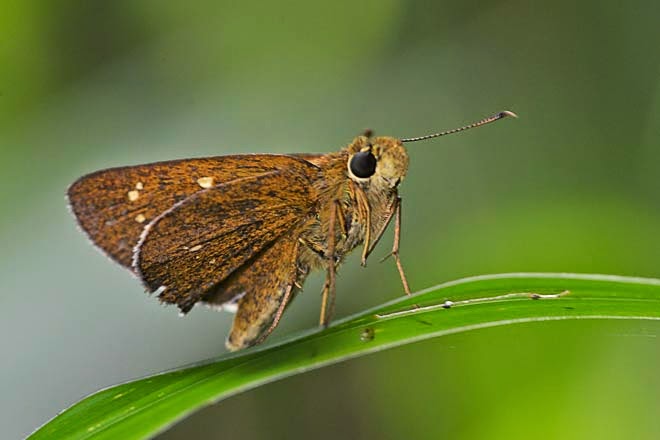
I sped up my pace walking towards the boardwalk. Beside the SICC golf course, a few skippers caught my attention even though they were resting in some shade. I believe this was a Palm Dart (Telicota augias augias). 
This is likely to be a Lesser Dart (Potanthus omaha omaha).
A wasp was busy feeding on some flowers of the Mile-a-Minute. 
Just before the Golf Link boardwalk, I noticed a a Logania  marmorata damis kept fluttering erratically. It finally perched underneath a leaf where some ants were present too.
I turned back as time didn't allow me to wait for this skittish guy to perch again. On may way home, on the same Leea indica shrub, a Yellow-veined Lancer (Pyroneura latoia latoia) was hooked on one isolated flower for a long time.
The female Malayan Baron (Euthalia monina monina)  was puddling on the trail leading to Lornie Road.
I was quite surprised that the butterfly activities were quite good in the late afternoon. Perhaps it was due to the morning rain that they had to feed late in the afternoon to get enough food for next day.

Sunday, May 25, 2014

From Lornie to Venus

I could feel that too much eating and too little exercise during a recent short trip to Melbourne (29 Apr - 2 May) had added some extra calories to my body. So I decided to go for a long hike on a fine Saturday morning (10 May) - from Lornie Trail to Rifle Range Link and ended up at  Venus Drive. 

For a long period of time, there wasn't  any clear shooting opportunity along the Lornie Trail except for this striking red fruit (or was it a seed pot , not sure what this is).
At last, I encountered a lycaenid flying rather erratically at the reservoir edge. I stood still and locked my sight on it until I could snap a few shots.  I believe this is a male Nacaduba berenice icena (The Rounded Sixline Blue).
While it was walking on a dry tree stem, I took more shots.
I had to bear the scorching heat while walking on a stretch of  tarred road between the reservoir and the golf course. I thought some selective tree-plantings on both sides of the road not only would provide shade for joggers and trekkers, they definitely would add greenery and aesthetics to the current not-so-scenic view of this part of the reservoir.  
Another awful sight (for me at least) is this very wild "grassland" in the heart of our nature reserve - I am puzzled why it has been like this since the day I started photography as a hobby.
At last I came to a more pleasant scene at the Jelutong Hut. More than half a dozen of Striped Blue Crows
(Euploea mulciber mulciber) were flitting around and puddling on the cement floor and seats. Strangely, I could  not find any female. 
The proboscis was seen "scratching and tasting" the concrete slabs.
A male Cruiser (Vindula dejone erotella) was flapping its wings while it was puddling on the cement floor in the shelter.
This underside shot was a bonus for me after a few attempts to freeze the wings at the correct moment.
While resting at the hut and observing the behaviour of these butterflies, here came another male visitor - the Magpie Crow (Euploea radamanthus radamantus).
I continued my hike towards the Rifle Range Link. The place where we used to lie flat on the ground to shoot puddling butterflies was flooded and had become a "river". Nevertheless, I was luck to bump into a small sandy patch where some butterflies seemed to like it very much.

I have not been shooting a Tree Yellow (Gandaca harina distanti) for a long time. It was seen puddling on a patch of damp soil along the Riffle Range Link.
This Tailed Jay (Graphium agamemnon agamemnon) appeared from no where but also disappeared from the scene the moment I snapped an impromptu shot.
This Fivebar Swordtail (Pathysa antiphates itamputi) was slightly more cooperative.
Another common species around the area was the Common Bluebottle (Graphium sarpedon luctatius) but they were also active and alert. Perhaps these butterflies need some special nutrients for them to stay on the ground longer.
There were a few smaller butterflies nearby. I seldom chased a Brown but this Mycalesis which appeared to be the The Dark Brand Bush Brown (M. mineus macromalayana) was on the ground longer than I had expected.
A few smaller lycaenids were flitting around nearby too. They looked common to me so I didn't bother much of their presence. Two different Prosotas species were there - the Common Line Blue (P. nora superdates) and the Tailless Line Blue (P. dubiosa lumpura); no luck for me to see and shoot a third species. 
Another male Rounded Sixline Blue was very sensitive towards flash light - but this behaviour allowed me snap a glimpse of its uppersides.

Lastly, let me pose two skipper shots - awaiting for confirmation of their identities. I suspect this is a Contiguous Swift (Polytremis lubricans lubricans)
And this is likely to be a Potanthus omaha omaha. 
 must say this was the most fruitful hiking and photographic outing I have had this year.