Sunday, September 10, 2023

Lung Kwu Tan (龍鼓灘) & Luk Keng (鹿頸), Hong Kong

Continued from last post.
Our HK friends were not free on 5 and 6 July, so we were on our own to explore two butterfly hunting sites.

This small Tagiades species was my first shot on 5 July at Long Ku Tan. However, it always landed underneath a leaf, making it very difficult for me to snap a good shot. I was puzzled by the absence of the white outer margin of a normal T.  menaka that I used to encountered. 

I went up the steps leading to the Emperor rock (didn't reach the peak this time) and bumped into this Club Silverline (Spindasis syama) and a rather large dark brown skipper that looks like a Boaris farri.


The Falcate Oak Blue (Mahathala ameria) seemed to be quite common at Long Ku Tan as I spotted at least three or four individuals. 
This looks like the Transparent Sixline Blue (Nacaduba kurva)
The Common Gull (Cepora nerissa) came to feed late in the afternoon at a wasteland where the Bidens flowers were abundant. 
On 6 July, we took the East Rail Line to the Fenling Station and transferred to the green mini bus 56k (every 30 min interval) bringing us to its terminal station at Luk Keng village. On our way to the village, I bumped into this Chestnut Angle (Odontoptilum angulatum) on the road side.
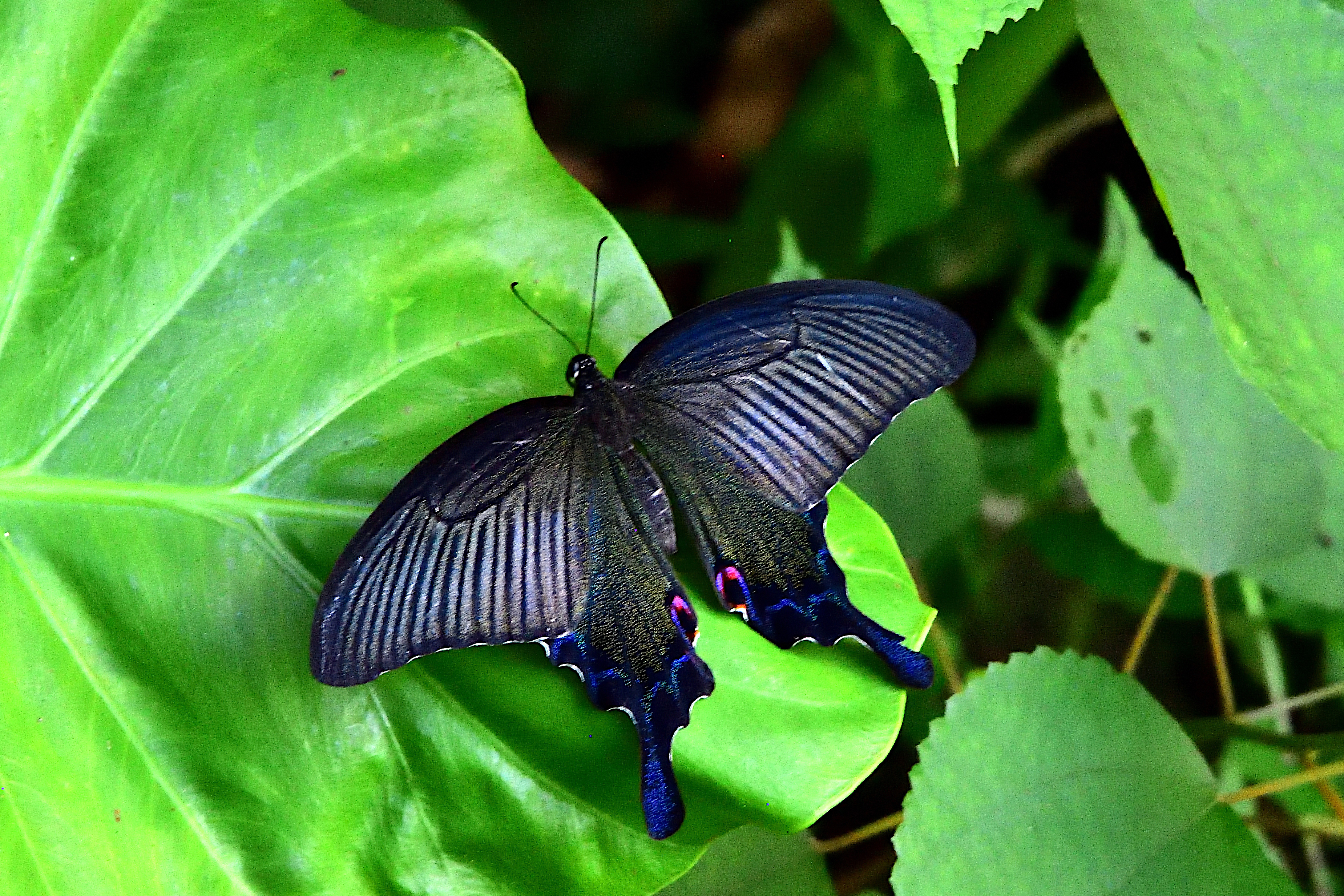
Our first shot at the village was the  Papilio protenor (Spangle) feeding gracefully on the flowers.
We had to take cover at a corridor of a block of apartment while waiting for the passing-rain to stop.
Shortly after the rain, we were very lucky to spot the Lethe rohria.
The Bamboo Tree Brown (Lethe europa) and a mating pair of the Common Palmfly (Elymnias hypermnestra agina) were seen at the vicinity.

The weather turned very hot after our lunch but the number of butterfly species was rather disappointed. Along a forest trail along a slope, we encountered a group of puddling butterflies on a rotten fruit.
We waited awhile, trying to isolate them. The Commo Duffer (Discophora sondaica) refused to go away after the Archdukes were "reset"
A few male and female Archdukes (Lexias pardalis) were flying low and looking for puddling spots .
An underside shot of a female.
In the late afternoon, while walking down the same slope, I bumped into this Chinese Peacock resting on a leaf surface.
This Lethe confusa was surprisingly tame for me to take a few shots.
A few skippers were zipping around. I had to be patient and observant to track them if they had landed.
This should be a Parnara ganga.

Along a cement road leading to the end of the village, a lonely Common Nawab (Polyura athamas) was seen puddling.
The Bidens flowers growing in the grasslands on both sides of the road attracted quite a number of small skippers; they were flitting amongst the flowers. This is the Jhora Scrub Hopper (Aeromachus jhora ).


A Bush Hopper (Ampittia dioscorides) resting on a blade of grass.
Under the hot afternoon sun this Lemon Pansy (Junonia lemonias) was highly active, visiting different Bidens flowers frequently but without a long perch.
Hong Kong has many butterfly-hunting sites that we did not visit in this trip - we will be back again in the future.  

Sunday, August 6, 2023

Lions Club Nature Education Centre & Tai Po Kao, Hong Kong

I had to be in HK to resolve a banking issue sooner or later. During a weekly shooting at Lornie PCN in May, I bumped into Ash and got to know that he would be in HK until 7 July. So I decided to join him for butterfly-shooting.  To save time and cost, I booked a midnight CX flight, arriving on a Sunday dawn. 

Within 2 hours of touching down in HK, I arrived at our hotel along Nathen road near Tsim Tsa Tsui  MTR station. Leaving my small luggage in his room, we went for breakfast just next to our hotel. After breakfast, we met our HK friend Wendy at the Yau Ma Tei MTR station and walked to a mini-bus stop, hopping on the bus going to the Lions Club Nature Education Centre in Sai Kung. 

This 34-hectare huge outdoor education centre includes quite a number of smaller themed parks or enclosures such as an arboretum, a medicinal plants garden, a tree nursery and a rock-and-mineral garden etc.   
The cloudy sky and the intermmiten passing rains did dampen my excitement of hunting and shooting in HK again.  However, we still managed to see a good number of Blue Tigers and a few skippers.

 The Restricted Demon (Notocrypta curvifascia) was found at the edge of a lily pond. 
A glimpse of its forewings.
This is a Dark Evening Brown (Melanitis phedima) 
The cooling and poor weather did not stop a large colony of Blue Tigers (Tirumala limniace) from fluttering and feeding on some wild Latana flowers.
We had an early lunch inside this education centre while waiting for the rain to subside. After checking the weather forecast for the rest of the day, we knew that there was no chance of a clear sky. We decided to head back to the bus stop.  Along the way, we saw a shy Punchinello (Zemeros flegyas) hiding behind a leaf.
We found a green praying mantis at the lily pond. Its triangular head was turning and looking at us.
Many thanks to Wendy for spending the day with us.
 
I didn't go out with our HK friends to shoot on Monday 3 July as I went to HSBC Aberdeen branch to  change my mobile number in their system (a mistake made by a counter staff in March). This time, I must thank this young lady who had patiently checked and made sure I could setup and use the mobile and internet banking before I left the branch. After that I visited my ex-colleagues and friends in the late morning and afternoon. 

I resumed shooting on Tuesday and  we met up with our friends again, this time 10 am at Tai Po Market MTR. We took a cab (about HK$25) to the Jc Castle (龍成堡).  We were welcomed by a short-lived passing rain the moment we reached a service road next to this private property. We walked up a tarred road followed by some gradual steps before climbing another long flight of steps to reach the peak - this is the same hill top  that I shot the Papilio agestor (Tawny Mime) before.
This hill top was always crowded with photographs in some months. But this time, six of us had the luxury of space to roam around this small hill top.  I found a rather pristine Shan Nawab (Polyura nepenthes)  resting high on a leaf. 
There were quite a few male Colour Seargents (Athyma nefte) circulating around this hill-top - a typical hill-topping behaviour for finding a mate.
They had the tendency to perch on a high leaf.
There was another Sergeant flying around but it was very active. This is the Blackvein Sergeant (Athyma ranga).

Very often, we could find the Constable (Dichorragia nesimachus) on this peak.
After awhile, it became quite friendly with our presence. Thanks to Lc Lc for being very patient, waiting for us to shoot when it landed on his fingers.
Another common species that can be found here is the Indian Fritillary (Argyreus hyperbius). 
A rather tall flowering tree attracted a few butterflies. This is a Classy Bluebottle (Graphium cloanthus) - a record shot of this fast flyer which didn't stay still on the flowers.

Quite a few lycaenids also came to visit the flowering tree but they looked so small on my camera viewfinder even though I was using a 28-300 mm lens this time. 
This is a rather fading Green Flash (Artipe eryx) perched on a leaf for sometime
We got excited when the rare Royals turned up though high on the tree - there were at least two or three Silver Royals (Ancema blanka)feeding at different flowers.
This was my first sighting and a record shot of a rare Spotted Royal (Tajuria maculata)  
 
The view from the peak (荔枝山 ) is nice
We had about 2 hours of shooting on this peak. Around 2 pm, we noticed that a large patch of dark clouds was approaching us so we decided to depart. True enough, a heavy downpour came the moment we reached a shelter. Once the rain subsided , we walked down the tarred road towards the 松仔園 (Chung Tsai Yuen) direction.


Thanks Wendy, Jacky, LC and one more lady whom I cannot remember her name for accompanying us shooting.

Note:  I remember on the first day of 2018 (I was still working in HK in 2018). I took the train to Tai Wai station and boarded a KTM bus 72 going to 松仔園 (Chung Tsai Yuen). Walking up leisurely along the main tarred road on a nice and early Monday morning, I spotted a skipper puddling on the tarred road from far.  I approached it quickly and to my surprise with great excitement, it was a rather pristine Choaspes benjaminii  or could it be C. hemixanthus? 
Another shot


Tuesday, July 25, 2023

Lornie Nature Corridor Part 2

Continue from part 1 here.  
In this post, I would share pictures of smaller butterflies mainly from the Lycaenidae (Blues) and Hesperiidae (Skippers) family that I have taken over a period of a few months when I dropped by at this place 

This is one of the largest Oakblue butterflies that can be found here - The Centaur Oakblue (Arhopala centaurus nakula).

This tailless Oakblue is the Arhopala major major appeared in a late afternoon. 
A clear upperside shot of any Arhopala species is considered a lucky shot. I was indeed at the right place and the right time  witness  the "opening ceremony" of the wings.
Some not so common butterflies did show up here. This is a female Dark Flat (Tapena thwaitesi bornea) which came out to feed around 11 am.
This pristine male was shot along a dirt trail a week ago. The life history of this species has been excellently documented here.
The Large Snow Flat (Tagiades gana gana) is another common visitor to this part of the park connector.
Another fresher specimen.
This is the Ultra Snow Flat (Tagiades ultra) seems to be getting more common as I have seen it a few times. 
We tend to  see the Common Snow Flat (Tagiades japetus atticus) either feeding on flowers in the morning or resting underneath a leaf.
  
This is another specimen resting on the railing.

From far, it looked like some different sizes of orange mosaic tiles floating in the air,  The Hieroglyphic Flat (Ordina hieroglyphica ortina) is not so common but an attractive butterfly. I usually find it feeding on bird droppings.
This very dark skipper is a male Quedara monteithi monteithi 
Her uppersides
This is a female specimen.
The proboscis of a skipper can be very long, like a fishing line. Thie one looks like a Bengal Swift (Pelopidas agna agna) 

The Malay Dartlet (Oriens paragola) seems to be getting more common these days. 
This is another specimen feeding on some Leea indica flowers.

Any small orange skipper is always a challenge to identify with certainty. But I am quite sure that this is the Yellow Grass Dart (Taractrocera archias quinta).   
Its uppersides. 

The Great Imperial (Jacoona anasuja anasuja) was spotted and shot by a  few people over a period of a few weeks.  I managed to shoot this female on a late morning when a fellow butterfly enthusiast John alerted some of us.   
Just a glimpse of her uppersides.
Another long-tailed butterfly but this species the Fluffy Tit (Zeltus amasa maximinianus) a lot more common than the Great Imperial.
From this upperside shot, I know that this is a male.
This Abisara geza niya demonstrated a typical behaviour of a Judy - it kept hopping around with its wings partially open.
I was lucky to get a few shots of a rather pristine Chocolate Royal (Remelana jangala travana) which was found resting on a leaf with its four white-tip tails spreading out quite evenly.   
Another shot from a different perch.
The Common Awl (Hasora badra badra) was zipping around and all of a sudden, it landed on a blade of grass in front of me.
 

The Apefly (Spalgis epius epius) prefers shady environment.
This Yamfly (Loxura atymnus fuconius) was found puddling on the tarred park connector.
This rathe cute black-and-white lycaenid is rather common in our forest, usually puddling on the ground. It was nice to see them feeding on flowers.
The Cornelian (Deudorix epijarbas cinnabarus) was rather abundant at times. This pristine specimen was feeding on the Bidens flowers before taking a short perch on a leaf.
Another specimen shot on a different day. 
However, the Eliot's Cornelian (Deudorix elioti) is not as common as the Cornelian. I have seen it once here, high on a tree.
A few look-alike species can be found along this trail. This is likely to be the Pointed Line Blue (Ionolyce helicon merguiana)

I believe this is an Opague Sixline Blue (Nacaduba beroe neon)
This is The female Opaque Sixline Blue (Nacaduba beroe neon) perching high on a twig.

Some us played host to a group of Hong Kong butterfly enthusiasts from late May to early June.  On a fine Sunday morning on 5 June, they encountered this mating Large Fourline Blue (Nacaduba pactolus odon) 

This Pysche (Leptosia nina malayana) is from the Pieridae family.  It usually flutters slowly close to the ground level but getting a shot of this species needs a lot of luck and patience as it does not perch for long.
It is now quite obvious that a habitat with wild flowers and plants near a forest fringe seemed to attract more species of butterflies. Let's hope that Lornie Nature Corridor and the stretch of wasteland near MacRitchie Reservoir continues to provide nature photographers an interesting location for watching and photographing butterflies.