Sunday, February 24, 2019

Flora and Fauna of Tampines Eco Green Park

It has been more than 3 years since my last visit to this nice and wild place in the northern part of Tampines town. Yes, I am referring to the Tampines Eco Green. After coming back to home for good last July, I had visited the park twice. 

I noticed that the shrubs at the south entrance have grown a lot taller and the number of butterflies have dwindled quite a bit - perhaps due to the construction work currently going on along Sungei Tampines.

As usual, many Plain Tiger butterflies (Danaus chrysippus chrysippus) were there to welcome me on both occasions. Yes, with the host plant, the Crown Flower (Calatropis gigantea) doing well, we are bound to see this elegant butterfly fluttering around. 
A female was ovipositing her eggs
After taking a shot of the flower buds, I noticed that a critter was lurking nearby, waiting to strike any Plain Tiger going there to lay eggs?
A close-up shot of the spider - I wonder what this is?
Besides the Plain Tiger, I encountered a few other butterflies. One of them was this very alert and skittish male Common Tiger (Danaus genutia genutia).
To fully appreciate nature and be able to see some small but interesting critters, we need to slow down and look around without any other interfering thoughts in our mind. 

These small creatures can be spotted quite easily if we pay a bit attention to our surroundings. This is the Bush Hopper (Ampittia dioscorides camertes), a small skipper resting on a blade of grass.  
Same pose - but I moved a few steps away from it. 
Another specimen showed its upperside wings.
A very small nymph of a katydid was feeding on the Coat Buttons flower (Tridax procumbens). 
This tiny and beautiful Ricaniid planthopper (Ricanula stigmatica) is quite common in grasslands. But you will miss it, if you don't stop and look around. 
A few male Potanthus species were "chasing and fighting" before they settled down on a leaf surface with wings open - so I had no chance of taking an underside shot to identify them.
A different male specimen displayed the same behavior of opening its wings immediately when it perched.
A poor skipper, a Telicota species I believed was trapped in a spider web. While it was struggling to flee itself, I was thinking should I offer a helping hand. At the end, I didn't.  
The Long Banded Silverline (Spindasis lohita senama) is one of the star butterfly species that many of us would love to shoot. 
Another more pristine specimen.
Unlike many other urban parks in SG, the Tampines Eco Green integrates much of the original natural and wild grassland and woodland habitats as the main concept of this huge natural park in Tampines town. Apart from many interesting critters that have established their home there, numerous attractive wild flowers were abundant too.

A pair of Moring Glory (Ipomoea cairica) flowers captured my attention for photographing. 
This small yellow flower is nice and attractive. 
Before the south entrance, a few bushy shrub with many attractive flowers stood out and aught my attention - I believe these are the flowers of the Kopsia fruticose.
I watched with a great worry for the waterhen as it didn't seem to know that the Malayan water monitor (Varanus salvator) was quite close to him.


Tuesday, February 5, 2019

A Rarity @ Dairy Farm Park

Wising all Chinese readers of the blog a happy and healthy lunar new year.   

Some FB posts of the Malayan Jester (Symbrenthia hippoclus selangorana) caught my attention some weeks ago. It was spotted at the Dairy Farm Park so I decided to find out on a fine Sunday morning (27 Jan). Indeed, the moment I arrived at Car Park B, I did see a solitary Jester flitting around and occasionally trying to puddle on the ground. But it was too skittish for me to get a shot and it preferred to stay at the canopy level. 

Instead of waiting for it to appear again, I decided to explore the Wallace Trail - but it was disappointing so I decided to turn back to Car Park B. 

Noticing a few orange skippers sunbathing on grasses, I focused on this small Detached Dart (Potanthus trachala tyleri) instead.

Shortly after it settled on a perch, it had the tendency to open its wings.
I adjusted my shot slightly.
There were too many people moving around the toilet area, so I walked towards Car Park A . Along the way, I bumped into a Malayan Sunbeam (Curetis santana malayica) resting under a leaf.
The sky was getting cloudy, so I went back  to Car Park B again and hung around at the toilet area, waiting for the Jester to appear. In the mean time, a female Common Posy (Drupadia Ravindra moorei). 
Finally, a rather pristine Malayan Jester was seen flitting around and puddling on the ground occasionally. It was extremely skittish, never staying still for me to compose a close-up shot. This was the only decent shot when it landed a few meters away from me. In fact, this was my second sighting of this rare species after 7 years. 
After shooting the Jester, I noticed a docile Grass Demon (Udaspes folus) was hiding among some leaves. I got to push aside the obstructions to snap a few shots. 
Shooting from the top when it decided to open its wings partially.
Before I went back home, I took a last look at an open area just beside the Wallace Education Centre. A Malayan Eggfly (Hypolimnas anomala anomala) was found resting on some ferns.  The life history of this species has been well documented here


Sunday, January 27, 2019

Butterflies of Northern Thailand Part 7 (Papilionidae and Pieridae)

Continue from previous post

Butterflies in the Papilionidae family are usually showy, large and strong flyers. There are more than five hundred species worldwide. Let me begin with this Common Windmill (Byasa polyeuctes) which appeared on two consecutive days when we were at Chiangdao.
 It was nice to have two in one picture.
An upperside shot of a Common Windmil at the puddling ground.

The Great Windmill (Byasa dasarada) and the Common Windmill look alike.
We didn't get to see many Burmese Batwing (Atrophaneura varuna zaleucus ) in this trip
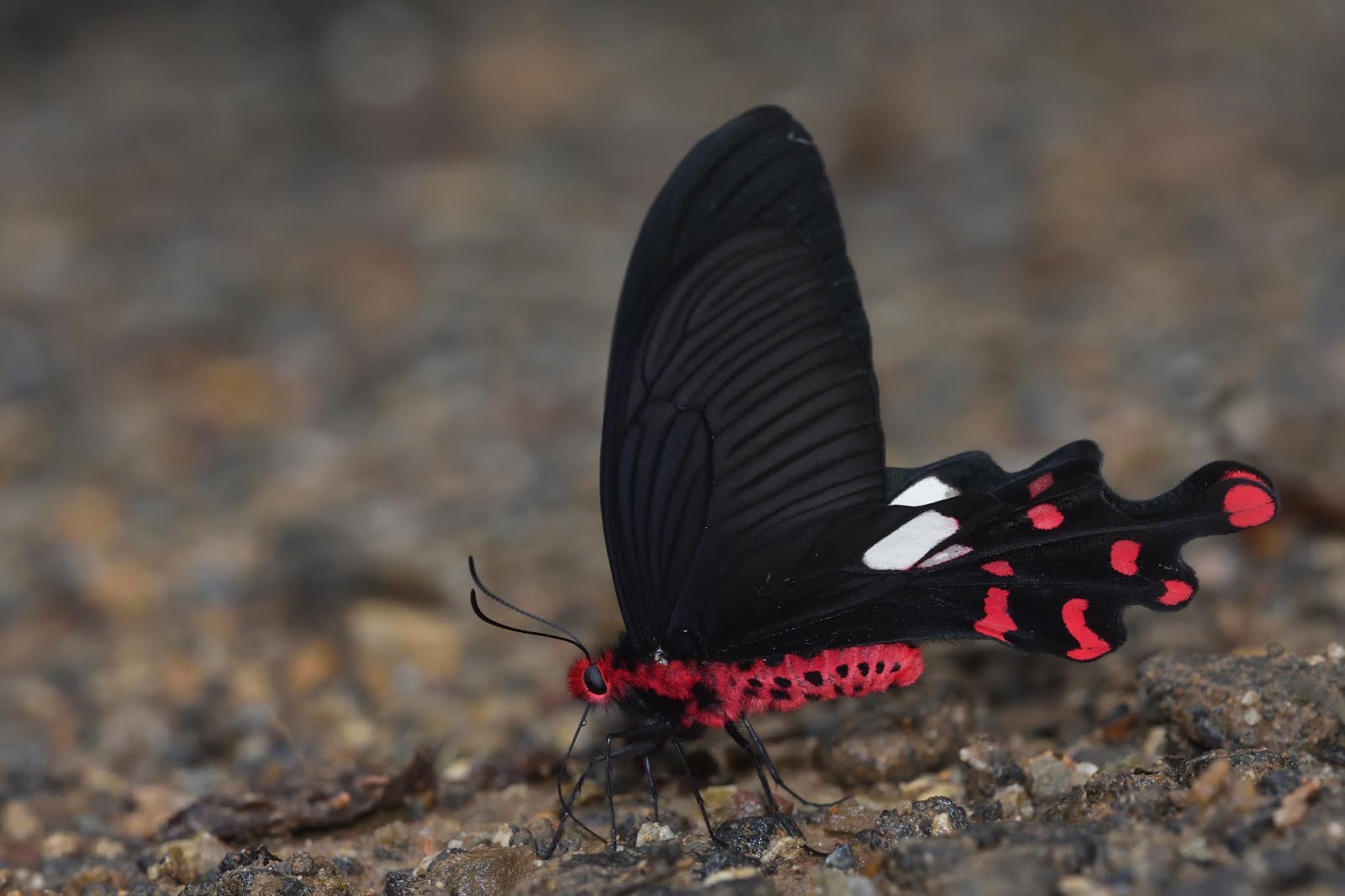
This is a Common Batwing (Atrophaneura varuna astorion)
A Redbreast (Papilio alcmenor f. leucocelis) rested on ferns at Chiangdao.
A pristine female Great Mormon (Papiliio memnon f agenor) at Mae Kampong.
Of course the Paris Peacock (Papilio paris paris) and the Green Dragontail (Lamprotera meges) were plentiful as usual at the Chiangdao
We didn't get to see and shoot many butterflies from the Pieridae family in this trip.

The subspecies indica of the Painted Jezebel (Delias hyparate) in Chiangmai  is more yellowish on the underside of the hindwing.
The Cepora nadina nadina (The Lesser Gull) was quite abundant at three different locations we stopped by in Mae Kampong.
This is the Hill Jezebel (Delias belladonna hedybia) found at Chiangdao puddling ground.
I have come to the end of this series of blog posts that showcase some butterflies found in areas around Chiang Mai -  Yes, I have taken too long to complete it.   

I had a wonderful time with Antonio in the field. A bonus I got from this trip was getting to know Andy Ho from Hong Kong and shooting together with at Doi Suthep on 16 Oct 2018 before my afternoon flight back to Singapore.

Once again, I must thank Antonio for bringing me around and making all the necessary arrangement for making this trip possible.  See you next time perhaps not in Chiang Mai again.

Saturday, January 5, 2019

Butterflies of Northern Thainland Part 6 (Satyrinae Subfamily)

Continue from previous post

Satyrinae is one of the largest subfamilies of the family Nymphalidae.

The genus Elymnias species are commonly called Palmfly. The Spotted Palmfly (Elymnias malelas malelas) has very nice shimmering iridescent blue on the upper side of the  forewings.
The Tiger Palmfly (Elymnias nesaea) appeared at Chiangdao puddling ground - this was a new addition to my photo collection of butterflies of Chaingmai.   
A male Red-tailed Forester (Lethe sinorix sinorix) stayed rather still on the ground - this particular spot attracted some other butterflies too.
Another specimen was spotted at a higher altitude at Chinagdao.
An upperside shot.
The Banded Treebrown (Lehe confusa confuse) was 'hopping around' - not new to me, so I gave up chasing it after taking this shot. 
I saw quite a few Ring butterflies (Ypthima  species) at Doi Chiangdao but they were rather alert and rarely gave me a good pose with a longer duration. This was a snap shot of  the Ypthima savara.

In the field, I wasn't very sure which Fivering this was. I think this is a Common Fivering (Y. baldus). 
A mating pair of the Y. savara
When there was nothing else to shoot, an unattractive but docile Ypthima confusa could be quite rewarding.
Very often we could find the Bushbrown (Mycalesis species) amongst the Rings. Looking at the prominent white band, we could understand why this is called the White-line Bushbrown (M. malsara).
The postdiscal ocelli (eyespots) of the Mycalesis suaveolens are usually very small.
It was a 'quiet' day when we were at Mae Kampong. In the late afternoon, we encountered  a fast-flying and large butterfly teasing us. Antonio was able to identify it as the White Owl (Neorina patria). Indeed it was a White Owl when it finally perched on top of some leaf litters.  
We had to trek quite a bit before we encountered a Tiger Brown (Orinoma damaris)  - an uncommon species.  When it t flew past us and landed on a leaf surface at our eye level, we quickly took some shots.
To be continued.