Along the row of Syzygium hedges along the roadside, I found lots of planthoppers on one of the shrubs.  A few wasps or perhaps hornets were foraging on the leaf surface on the same shrub as these planthoppers . Not sure if this is a Banded paper wasp (Polistes sagittarius).
 And this Yellow-vented hornet (Vespa analis) was seen stopping on the leaf for quite a while. I have no idea what it was trying to do.
  We only have four butterfly species belonging to the genus Flos and this Flos apidanus saturatus has been the most commonly seen in the nature reserves. She landed on a young leaf and slowly walked forward on the stem, looking for a spot to lay eggs.


A few wasps or perhaps hornets were foraging on the leaf surface on the same shrub as these planthoppers . Not sure if this is a Banded paper wasp (Polistes sagittarius). And this Yellow-vented hornet (Vespa analis) was seen stopping on the leaf for quite a while. I have no idea what it was trying to do. We only have four butterfly species belonging to the genus Flos and this Flos apidanus saturatus has been the most commonly seen in the nature reserves. She landed on a young leaf and slowly walked forward on the stem, looking for a spot to lay eggs.She found it. The larva is known to have close association with ants. As you can see here the eggs were laid near some ants. If I had said it loudly ' Hi, mother Flos apidanus saturatus, don't be shy, let me see your face", pherhaps my shot would not had been obstructed.


Here is a picture of the host plant, a tall tree perhaps a Syzygium species
 This Yamfly (Loxura atymnus fuconius) was shot at the water edge. A few of them, all lost their white-tipped tails, were seen sunbathing occasionally. Read more about this species here.
 Here is another shot that shows us a glimpse of a bright orange patch on the upperside forewing.
 The Knight (Lebadea martha parkeri) is quite common in some parks and our forest. Very often, it prefers to glide and perch on a leaf surface with wings fully open.
  My first shot of this relatively rare Colonel (Pandita sinope sinope) at USR was way back in 2005. Here was the shot taken then.
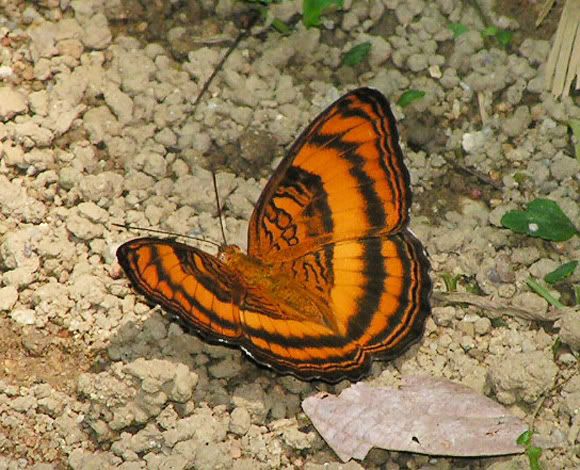 This was my second encounter of this species here after four years. As usual, a very skittish guy, it preferred to stay high up most of the time.
 It is rather hard to spot a Dark Blue Jungle Glory (Thaumantis klugius lucipor) resting on the forest undergrowth as it blends very well with its environment. Very often its presence was noticed only when it was in flight as its very intense and magnificent metallic blue upperside surly caught our attention. The camera flash light really brought out the spectacular colours of the underside as well.
  I have begun to notice and shoot more species of moth in the wild since I started this blog almost a year ago. I usually have no clue of what I shot, like this one, a small moth resting underneath a leaf. But I hope one day someone will drop by here and name the species.
 Another Yellow-vented-hornet (vespa analias) was busy feeding on the dry fruits and the flowers of the Singapore Rhododendron (Melastoma malabathricum).
  Wow, at one moment as if it was staring at me.
 This fungus grew on a fallen tree trunk and I think the grasshopper was risking its life resting at that open and prominent position.
  This was my best attempt at shooting an in-flight male Orchithemis pulcherrima. Not a good shot as it was a bit too far from me. I hope to get a better shot next time.
  I consider this a rather fruitful outing. Let see what I will find during my next visit to USR, well, that should be at least two or three weeks later.


 This small critter looks like a kind of cricket. It has long hind legs and a pair of long antennae, resting on a leaf opposite the
  There were a few butterflies visiting the
  Except for this brown skipper, a
  We saw this Dingy Line Blue (
 After enough sun-tanning at the
  I guess this is some sort of a fly with a long and yellow stripped abdomen.
  This large bracket fungus was found at shady place along the main trail.
  Another wild
  Neat the entrance of the Wallace Trail, I saw this shiny cocoon-like structure. A small fly was inside there as well. I wonder what it is .
  We went over to the "B Spa" area. This water snake was found at our usual hunting ground for butterflies. I have no clue if this is a poisonous snake.
  This large dragonfly,
  As Jonathan had to be home early, we didn't stay very long at the "B Spa". We headed back to the East, somewhere near
  A few other smaller butterflies were high up feeding. Fortunately, this Club
  We found another Syzygium tree full of flower buds. In the next few days, there should be some insect activities on this particular tree.

 This plant looks like an Ardisia species to me. My curiosity was aroused when I noticed that there were many leaves with holes, a definite sign of insects eating the leaves.
 This red beauty belongs to the Riodinidae family of butterfly. This should be a male Abisara species that I am not very confident of identifying it. Read
 These shots appear to be a Pointed Line Blue (Ionolyce helicon merguiana) perching on a leaf near the "playground" of the above Abisara species.
 The undersides of Ambon Onyx (Horaga syrinx maenala ) is predominantly ochreous brown with a prominent white band across both wings. I encountered three individuals chasing each other whenever an "intruder" came close to one's territory. This is one of my best instinctive snapshot as I hardly had any time to think and compose my shots on this guy.
  Colour Sergent (Athyma nefte subrata) seems to be a permanent resident at MF. This male was found along a row of hedges when he was sunbathing. I often encountered the male but not female.
 I am not sure if this tiny and cute critter is a froghopper. It was moving aimlessly on a stem but I had to follow it and aim hard to get this shot.
  No new species spotted but I was quite pleased to see and shoot quite a few butterfly species on a rather short weekday afternoon outing. Let's hope that one or two Vanessa species will visit us again this year.
 This is Lesser Grass Blue (
 This is Pale Grass Blue (

 This is a solitary

 This green
  This is a day-flying moth (
 A mating pair was found underside of a leaf. Usually the copulation takes at least an hour so that a sufficient number of eggs would be fertilised.


