My first shot of the morning was this cricket. There were so many of them along the road leading to the carpark. Having a pair of thin and long antennae, and powerful hind legs for leaping, crikets were often seen leaping from leaf to leaf. Yes, I have not seen a cricket flying far in the field.

This handsome male Changeable lizard (Calotes versicolor) was protruding his head out from a row of tall grasses as if looking for his meting partner because during the mating season, the males display bright orange coloration on their head and a black throat as shown in the picture.  This interesting all black with a little red eye creature looks like a species of ant or an ant mimicking a spider.
 Here is another shot. Pity that I am not tall enough to capture its dorsal view. After shooting this ant, I met Roy, an Nparks staff who was guiding a group of people from Starbucks (I hoped I heard it correctly) doing some voluntary community work there.
 Just next to the ant on a grass blade, I saw this katydid. We would miss its presence if we were not observant enough.
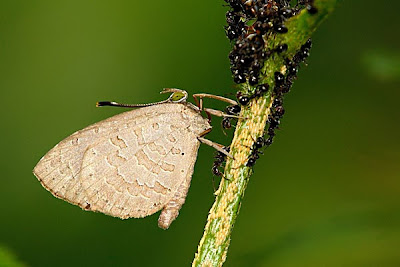
 There is a lot of interaction between species in nature. For example, this Lycaenid butterfly, Biggs's Brownie (Miletus biggsii biggsii) was usually seen having a close association with ants in the wild.
 John helped me to identify this digger wasp which belongs to the genus Sphex. From this dorsal view, we can see its big black bullet-shaped abdomen with brilliantly coloured legs.

This interesting all black with a little red eye creature looks like a species of ant or an ant mimicking a spider.Here is another shot. Pity that I am not tall enough to capture its dorsal view. After shooting this ant, I met Roy, an Nparks staff who was guiding a group of people from Starbucks (I hoped I heard it correctly) doing some voluntary community work there. Just next to the ant on a grass blade, I saw this katydid. We would miss its presence if we were not observant enough. There is a lot of interaction between species in nature. For example, this Lycaenid butterfly, Biggs's Brownie (Miletus biggsii biggsii) was usually seen having a close association with ants in the wild. John helped me to identify this digger wasp which belongs to the genus Sphex. From this dorsal view, we can see its big black bullet-shaped abdomen with brilliantly coloured legs. It looked like searching for food on the leaf surface and at one moment it was buzzing around me and I had to keep very still and bend my head low.
A sap-feeding and a moth-like insect, this is a beautiful Ricaniid hopper (Ricanula stigmatica) which was resting (or feeding ?) on the edge of a leaf.  Chocolate Pansy (Junonia hedonia ida) is a very common butterfly which can be found along forest fringes or in town parks but getting a good shot in the wild is never easy. I was lucky to have this rather skittish one perched in front of me for a few seconds - instinctively, I fired a few shots.

Chocolate Pansy (Junonia hedonia ida) is a very common butterfly which can be found along forest fringes or in town parks but getting a good shot in the wild is never easy. I was lucky to have this rather skittish one perched in front of me for a few seconds - instinctively, I fired a few shots.You will not miss a few clusters of tall African Spiral Flag (Costus lucanusianus ; Family : Costaceae) in the vicinity of the park. Its big and showy flowers often attracted carpenter bees visiting them.  This Noctuid moth was shot in the deep undergrowth along Wallace Trail. The two prominent eye spots on the forewings and the wing patterns can really scare a predator even a person away.
 This black and white Tumbling Flower Beetle with a pointed tail-like structure belongs to the genus Mordella. Not sure why it is called a Tumbling Flower Beetle.

I guess this is a St. Andrew's Cross Spider. Spiders generally are not attractive to me but I find spiderwebs fascinating because of their delicate and complex patterns. I believe spiderwebs have given scientists idea to create new materials which are light and superstrong.This Noctuid moth was shot in the deep undergrowth along Wallace Trail. The two prominent eye spots on the forewings and the wing patterns can really scare a predator even a person away. This black and white Tumbling Flower Beetle with a pointed tail-like structure belongs to the genus Mordella. Not sure why it is called a Tumbling Flower Beetle.

I spotted this Common Grass Yellow (Eurema sari sodalis) which was trying to lay eggs along the tarred road. I waited a while and was lucky to see her laying one spindle-shaped egg on the upperside of a young leaf. I hope to find out the name of this plant later.
 It has been almost 9 months since I started this blog recording my sightings in nature. This is my 50th post this year. I am glad that I still have the stamina to update the blog quite regularly. Honestly, I felt like giving up updating at times when I had too many deadlines to meet in my busy work schedule.
There are lots of interactions between different or even same species in nature. These ants were attracted to something that I am not sure of though it looks like bird droppings.
 Looking forward, I hope I can persevere and sustain my effort in blogging, capturing more dynamic and fauna behavioural shots, perhaps incorporating short video clips.
Related posts :


 The underside wing patterns are quite pretty as well. Shooting this guy in the rain and gutsy wind was a big challenge as well as a test of my patience.
 There were quite a number of Dark Glassy
 This was one of the hungry ones feeding on the yellow flower heads of


 This strange and unknown creature was spotted along the boardwalk above my eye level. When it was in flight and flapping its wings, I could see an orange patch on its
 This
 This Oriental Whip snake (
 I have seen this mildly venomous snake a couple of times in our forested areas. It didn't seem to be aggressive and after watching it for a while I decided to move in closer to take some shots.


 Last shot of the day was this small kaytidid. It appeared to take an afternoon nap under the direct sun.


 This is a Banded paper wasp (Polistes sagittarius) which is likely to be the most common paper wasp species in Singapore. Because of its coloration and shape it is often mistaken for the


 I am confident that the good variety of flowers in the park will attract more butterflies and insects and hope that they will make this park their home, creating a vibrant and dynamic ecosystem in the park. This brown skipper looks like a Small Branded Swift (Pelopidas mathias mathias) which is a common species as its larval host plant is believed to be some grass species.
 Apart from the flora and fauna, some of the significant historical events that happened in Toa Payoh were also engraved on the wall in the Sensory garden. For example, do you know which year the Queen Elizabeth II, UK visited Toa Payoh ?


