Recognised as one of the World Heritage Sites by UNESCO in 2004 for its outstanding "universal values", Kinabalu Park has a lot to offer to nature lovers. Two of us (Yong and I) decided to stay one night (4 June) at Liwagu Suite near the Visitor Centre, at a high altitude of 1585 metres above sea level.
 This beautiful shrub (perhaps Medinella species, family Melastomataceae) with lots of edible berries can be seen almost everywhere in the park.
After an early breakfast at the Visitor Centre (a 10 min-walk from where we stayed), with a map in hands we were on the mountain trails - covering at least 4 to 5 km in about 3 hours. Perhaps we were a bit early, there were rather few critters out there to welcome us. But, we truly enjoyed the serenity and the coolness of the high mountain forest.
A bird flew off rather hastily and suddenly, a few metres in front of me. When I took a closer look, I found a bird nest with two eggs in a soil burrow.
 Along another forest trail along a river, two small and birds were seen hopping in the undergrowth of the forest.
  Wild mushrooms and fungi growing on fallen tree trunks covered with mosses or lichens were rather abundant along the forest trails.
After lunch, we decided to explore around the area near the Visitor Centre and the Botanic Garden just behind our room. This small lycaenid looks like a Lesser Grass Blue (Zizina otis)
 This rather alert lycaenid looks like a Common Hedge Blue (Acytolepis puspa) fluttering and puddling on a sandy ground .
.jpg) Another alert puddling Blue, this Common Line Blue (Prosotas nora) was found in the same vicinity of the Common Hedge Blue. Note that the markings and colour tone of these butterflies look slightly different from those found in Singapore and West Malaysia - must be different sub-species I guess.
Another alert puddling Blue, this Common Line Blue (Prosotas nora) was found in the same vicinity of the Common Hedge Blue. Note that the markings and colour tone of these butterflies look slightly different from those found in Singapore and West Malaysia - must be different sub-species I guess.
The markings of this rather small lycaenid look like The Malayan (Megisba malaya) which landed on Yong's pant for me to take a few shots..jpg)
The only "Ring" butterflies I could find is the Common Tree Ring (Ypthima pandocus) which could be seen quite abundantly at the meadow and forest fringes.
.jpg) This is a shot of its upperside in the late afternoon.
This is a shot of its upperside in the late afternoon.  An Euploea species was playing hide-and-seek with us. Though it was puddling on the cement ground, it was very unfriendly to our presence. This is my best record shot from far.
 We visited Sapi island on 6 June which is one of the five picturesque islands of the Tunku Abdul Rahman marine Park. It is just a 20-minute boat ride away from downtown Kota Kinabalu. Well-known for its crystal clear water and rich marine life, Sapi Island is a popular and excellent location for snorkeling and other adventurous activities such as diving.
Once again, Victor, Yong and I chose to explore the forest trail (the dotted line in the map below) which is less known and less-travelled according to our tour guide.

This female Plane (Bindahar phocides) was shot along the coastal area leading to the forest trail.
 The trail is not easy for the general public - climbing over fallen tree trunks, long and steep slopes would make you think twice of going forward. Before going up to the hilltop, there was this flowering tree that attracted quite a number of Jamides philatus - a very common species on the island.
 In my next update of this blog, I will feature quite a number of butterflies spotted at the Mari Mari Cultural Village.


 Instead of going to the Canopy Walk, I chose to explore the jungle trail. My first interesting sighting on the trail was this extremely striking red ginger flower growing at the soil level - a peculiar and interesting plant indeed which attracted a few passerby to take its picture.
 It was a hot day, most butterflies I encountered were very alert and active - only a few
 There were a few species of butterflies fluttering along the trail leading to the waterfall. One of them was this Purple Bush Brown (Mycalesis orseis)
  This is a
  The
The 


 On my first visit to this park on 29 May morning, I explored almost every corner of the park. The hilly terrain makes it a good physical fitness
  Next, I saw this
  Interestingly, I noticed this fly curving its abdomen, not sure what it was trying to do.
 A rather common
  Near a stream, a kind of white Jasmine flowers were in full bloom. This Chocolate Demon(
 The common name of this orange
  The
The 

 The smaller one was seen flapping its wings at a high speed. I managed to get a shot to show a glimpse of its upperside of the forewing - which looks like a male.
 Individually, these Grass Blue butterflies are not colourful or large enough to be attractive, but when you see them flitting around flowers close to the ground in good numbers, they actually create a dynamic and vibrant scene in the garden.


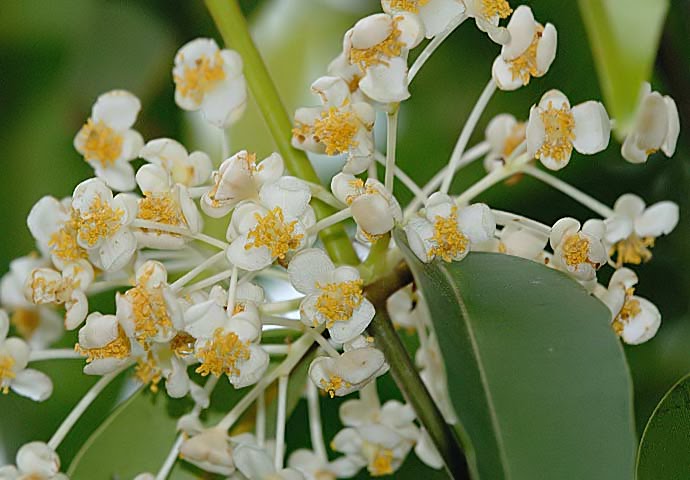
 We must thank these bees. Without them, the flowers would not be fertilised and bear these rather smooth and round
  The fruits turn purplish blue when they are ripe.
