With the completion of the Gardens by the Bay (GB) in the year 2011, Singapore is a step closer to achieving the vision of transforming itself into a "City in a Garden". Occupying more than 101 hectares of reclaimed land at Marina South, the garden has become one of the must-visit iconic places in Singapore. Besides the two indoor attractions - the Flower Dome and the Cloud Forest, the various theme outdoor horticultural gardens and pockets of "wild" places are particularly attractive to people who have a special interest in nature or macro-photography.
Despite a rather gloomy Saturday morning (18 May), I went ahead exploring the garden. It was good to see many people streaming towards the garden from the Bayfront Station.
My first shot of this small lycaenid Lesser Grass Blue (Zizina otis lampa) was taken near the Meadow Bridge. There were quite a few of them fluttering around at the ground level amongst some wild flowers.
In fact another look-alike species Pygmy Grass Blue (
Zizula hylax pygmaea) was mingling around with the Lesser Grass Blue - not easy to differentiate them apart unless we look at them on pictures.
While I walked towards the Fragile Forest, I saw a Blue Glassy Tiger (Ideopsis vulgaris macrina) feeding on some Lantana flowers in front of a giant sculpture of a sleeping baby, named as Planet by Marc Quinn, an renounced British artist.
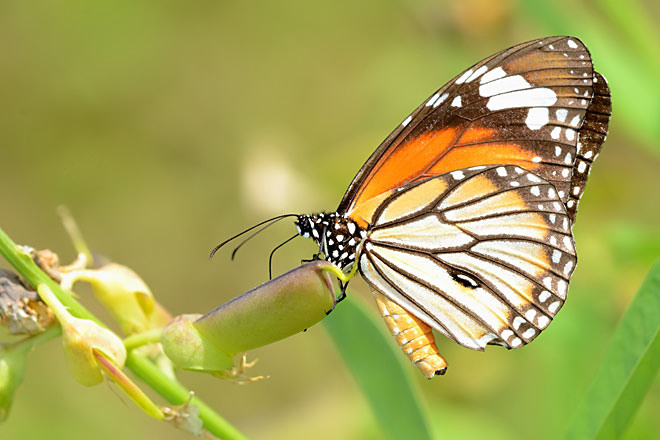
A skittish female Plain Tiger (
Danaus chrysippus chrysippus) was fluttering past me. She perched and took off a few times before settling on some leaves for me to snap a quick shot.
One best way to attract butterflies to the garden is to cultivate enough larval host plants. Soon we would be able to find more Plain Tigers because many different instars of the Plain Tiger larvae were feeding on the Crown Flowers (Calotropis gigantea).
The Common Grass Yellow (Eurema hecabe contubernalis) is quite abundant but taking a good shot is never easy.
These wild Bidens flowers provided a good source of food for different insects - a day-flying moth showed us how it enjoyed the nectar.
A row of Ixora blooms near the Bay South Meadow entrance attracted my attention. I strolled down the row and noticed this Plain Plushblue (Flos apidanus saturatus) - it was very sensitive to flash so I had to take a snap shot without the flash. It scooted off to the canopy after this shot.
It was almost noon when I reached Satay by the Bay-a dinning area where I replenished my energy level. Seeing the weather getting more cloudy with strong wind, I finished my food and drinks fast and went for another round of butterfly-hunting before the weather would not allow me to do so.
I walked towards the Ixora hedges. This Yellow Palm Dart (
Cephrenes trichopepla) rested on a leaf taking its afternoon nap.
This is another more pristine specimen - you cold notice that the sum in fact penetrated the dark clouds when this shot was taken.
In fact with patience, we could actually find quite a few species of butterflies visiting the flowers. At least two Painted Jezebels (Delias hyparete metarete) were seen fluttering around and visiting the flowers.
I wasn't fast enough to snap a shot when I first spotted a Peacock Royal (Tajuria cippus maxentius) landed on some Ixora flowers. I waited a while and finally it appeared again.
In fact, there was another specimen near by - appeared to be a female as the paler uppersides could be seen when it fluttered and changed its perch.
The Contiguous Swift (
Polytremis lubricans lubricans) zipped past me with high speed. But when it landed on a leaf surface, it had a tendency to open its wings.
There were quite a number of Mottled Emigrant (
Catopsilia pyranthe pyranthe) larvae and eggs on some Seven Golden Candlesticks (
Senna alata).
I witnessed this female Motted Emigrant laying a single egg on a young leaf before giving herself a well-deserved rest in a shade.
The Leopard (Phalanta phalantha phalantha) was quite abundant at GB but getting a good shot was extremely difficult as they were very sensitive to movement with a tendency of flapping their wings even on perch or feeding - this was a lucky shot resulting from "rapid firings".
Lastly, a surprise catch of the day was this Rustic (Cupha erymanthis lotis) which turned up at the Bay South entrance - but it was too skittish and shy for a better shot.
Apart from a good variety of flowers, a rich fauna diversity would add live and vibrancy to a garden. A group of ButterflyCircle (BC) members has completed a butterfly survey on a Sunday (19 May) and subsequently more BC members had photographed and recorded collectively close to 40 different butterfly species at GB (see a BC's blog
here) - I hope more butterflies, birds and other insects would frequent GB often with good numbers and thus making GB a unique and memorable outing location for both nature lovers and photographers.
In my next post, I will feature some non-butterfly critters and some beautiful flowers found at GB.