I tagged along with some staff members of Butterfly Lodge @ Oh' Farms who went on a guided tour to Kota Kinabalu (KK), Sabah. The fully-booked Jetstar flight touched down KK slightly behind schedule on 3 June. After a sumptuous chicken rice lunch and a rather long coach journey, we finally checked in at the Zen Garden Resort in the late afternoon.
There were many beautiful flowers outside our rooms.

The sun rises very much early here. I was awaken by the loud calls of roosters before 5 am. The morning cool highland breeze and fresh air swept away my fatique due to insufficient sleep. I explored the surrounding places and found a few green leaf beetles.
 This is a kind of firefly beetle I guess.
After breakfast, we were on our way to Poring Hot Spring - less than an hour journey. Our tour guide Clement knew where to find the lantern bug which belongs to the genus Pyrops in the order Hempitera. The contrastingly beautiful colours and patterns on the wings enticed many of us queing up to take a picture of it - only pity was that they stayed rather high up on the tree trunk.
 Instead of going to the Canopy Walk, I chose to explore the jungle trail. My first interesting sighting on the trail was this extremely striking red ginger flower growing at the soil level - a peculiar and interesting plant indeed which attracted a few passerby to take its picture.
 It was a hot day, most butterflies I encountered were very alert and active - only a few Laycaenids allowed me to take some shots. This shot looks like a Pointed Line Blue (Ionolyce helicon) taking a short break on a grass blade.
There was a waterfall at the end of the jungle trail where I shot this Nacaduba species - quite a few of them puddling on the moist ground or rocks. (note : Seow TL has identified this a male N. calauria)
 There were a few species of butterflies fluttering along the trail leading to the waterfall. One of them was this Purple Bush Brown (Mycalesis orseis)
  This is a Jamides species which was fluttering around some Torch Ginger flowers just outside the entrance gate of Poring Hot Spring.
 The upperside of this Blue is whitish without any metallic blue markings, she finally found a ideal spot to lay her egg.
In my next post, I will feature the critters I found at Kinabalu Park, Sapi Island and the Mari Mari Cultural Village.


 On my first visit to this park on 29 May morning, I explored almost every corner of the park. The hilly terrain makes it a good physical fitness
  Next, I saw this
  Interestingly, I noticed this fly curving its abdomen, not sure what it was trying to do.
 A rather common
  Near a stream, a kind of white Jasmine flowers were in full bloom. This Chocolate Demon(
 The common name of this orange
  The
The 

 The smaller one was seen flapping its wings at a high speed. I managed to get a shot to show a glimpse of its upperside of the forewing - which looks like a male.
 Individually, these Grass Blue butterflies are not colourful or large enough to be attractive, but when you see them flitting around flowers close to the ground in good numbers, they actually create a dynamic and vibrant scene in the garden.


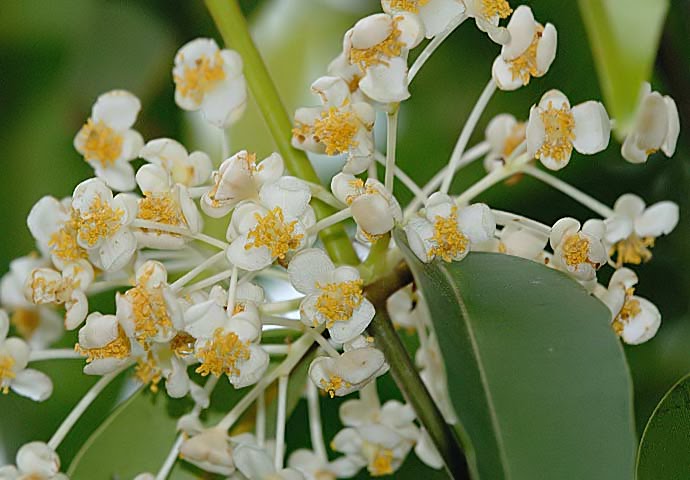
 We must thank these bees. Without them, the flowers would not be fertilised and bear these rather smooth and round
  The fruits turn purplish blue when they are ripe.
 I don't know how many species of planthopper in Singapore. It was my first sighting of this exceptionally small planthopper with a pair of light-blue furry wings which was found underneath a leaf besides the Ardisia shrub.
 I guess this is a species of fly with a pair of long antennae.
 The Leopard Lacewing (Cethosia cyane) was not seen previously by me in MNT though the species has established its permanent residence status in many parts of Singapore.


