My first shot of the morning on 12 September was this very tiny treehopper. A few ants were seen roaming around it and at times the ants even climbed over the body of the treehopper. Interesting interaction there but I don't know what exactly it was.
 BJ and CM came to join me late in the morning. BJ spotted this pristine female Archduke (Lexias pardalis dirteana) near the exercise station at LT. Usually, Archduke was seen on damp ground along jungle trail with both wings opened. Take a closer look at the apex of the antennae, the orange tips separate the other two lookalikes and rarer species from this species.
 There were quite a number of dragonflies and damselflies near the golf course area. I was always amazed by the acrobatic positions that Odonata species shown when they were in copulation positions. This brilliantly coloured mating pair of Ceriagrion cerinorubellum was no exception. I got a few shots taken from the edge of the reservoir at a rather low angle.
 There were a few very pretty blue damselflies which look like the shot shown here. This looks like a male Pseudagrion australasiae.
 A slow-flying pair was spotted just above the water surface. They were flying in tandem and it looked like the male was guarding the female. This in-flight shot was my best attempt out of many blur shots.
  Soon, the female was fully submerged in the water, ovipositing her eggs while the male was still in contact with her.
  The male let go the female but he was seen "waiting" for the female (not shown in the picture) while she was laying eggs underwater. After a while, when I used a twig to stir the water, the female got back to the same position as shown in the 2nd picture above.
 This rather large dragonfly with very striking yellow markings on its body kept darting from perch to perch. It looks like a Ictinogomphus decoratus. This particular specimen was very alert whenever I came close to it. I had to position myself near a twig, waiting patiently for it to land there. The pointed and triangular shape of the last abdominal segment is rather distinctive in this species.
  This is another shot on a different perch.
 Another relatively tamer and smaller dragonfly was nearby. This looks like a male Aethriamanta gracilis , a permanent resident in this area.
  This red dragonfly occasionally appeared in my sight. I am not sure if this is Rhodothemis rufa.
  On our way back to the carpark, CM spotted this spider on a palm leaf along the trail.
  Another lousy day for butterfly photography. The number of butterflies in our nature reserves has been quite pathetic for many weeks. Where have they gone to ? I wish I knew the answer.


.jpg) This interesting all black with a little red eye creature looks like a species of ant or an ant mimicking a spider.
This interesting all black with a little red eye creature looks like a species of ant or an ant mimicking a spider. Here is another shot. Pity that I am not tall enough to capture its dorsal view. After shooting this ant, I met Roy, an
  Just next to the ant on a grass blade, I saw this katydid. We would miss its presence if we were not observant enough.
  There is a lot of interaction between species in nature. For example, this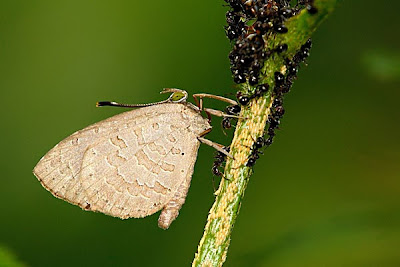


 Chocolate Pansy (
 This
This  This black and white


 It has been almost 9 months since I started this blog recording my sightings in nature. This is my 50
 Looking forward, I hope I can persevere and sustain my effort in blogging, capturing more dynamic and fauna behavioural shots, perhaps incorporating short video clips.
 The underside wing patterns are quite pretty as well. Shooting this guy in the rain and gutsy wind was a big challenge as well as a test of my patience.
  There were quite a number of Dark Glassy
 .jpg) This was one of the hungry ones feeding on the yellow flower heads of
This was one of the hungry ones feeding on the yellow flower heads of .jpg)


 This strange and unknown creature was spotted along the boardwalk above my eye level. When it was in flight and flapping its wings, I could see an orange patch on its
  This
This  This Oriental Whip snake (
 I have seen this mildly venomous snake a couple of times in our forested areas. It didn't seem to be aggressive and after watching it for a while I decided to move in closer to take some shots.

 Last shot of the day was this small kaytidid. It appeared to take an afternoon nap under the direct sun.


 This is a Banded paper wasp (Polistes sagittarius) which is likely to be the most common paper wasp species in Singapore. Because of its coloration and shape it is often mistaken for the


 I am confident that the good variety of flowers in the park will attract more butterflies and insects and hope that they will make this park their home, creating a vibrant and dynamic ecosystem in the park. This brown skipper looks like a Small Branded Swift (Pelopidas mathias mathias) which is a common species as its larval host plant is believed to be some grass species.
  Apart from the flora and fauna, some of the significant historical events that happened in Toa Payoh were also engraved on the wall in the Sensory garden. For example, do you know which year the Queen Elizabeth II, UK visited Toa Payoh ?